Why did I make this?
Another month, another game jam!
This small game was made in ~3 days for the Regenerate Game Jam 26.
A jam is a friendly competition between game developers who are tasked to create a complete game, based on a set theme, and in a very short period of time.
Although this time, there was no clear theme. The goal was to “make a game that celebrates futures that are sustainable, democratic, and equitable”.
Because I’m very interested in how we can, as creatives, set our works in desirable futures, I couldn’t miss this event.
Before the jam
I joined the jam Discord to find team members. As usual, I was hoping to team up with at least one artist, because custom art makes a game unique.
I saw the message of Derek, programmer and musician, who created Carbon Clicker, an incremental clicker game that shows the power of collective action to tackle climate change.
I played his game for way more time than I had planned to and asked him to join forces.
Leslie joined us as a 2D technical artist to complete the team.
The organizers were from New Zealand, so I had to do timezone math to convert the jam schedule to local time. Because of that, I realized a few hours before kick-off that it was effectively starting on that day. Oops!
First night
The jam was hosted by the IGDA Climate SIG, a “community of climate-minded game developers housed within an international nonprofit organization”, which provided the handy Game Developer’s guide to sustainable futures to help us design our games.
So we started brainstorming on an online whiteboard, around the four domains presented in the guide:
- Politics and the importance of democracy
- Nature People-Values
- Economy on a Finite Planet
- The role of Technology
For each one, we tried creating “ideas branches” that eventually ended with game ideas.
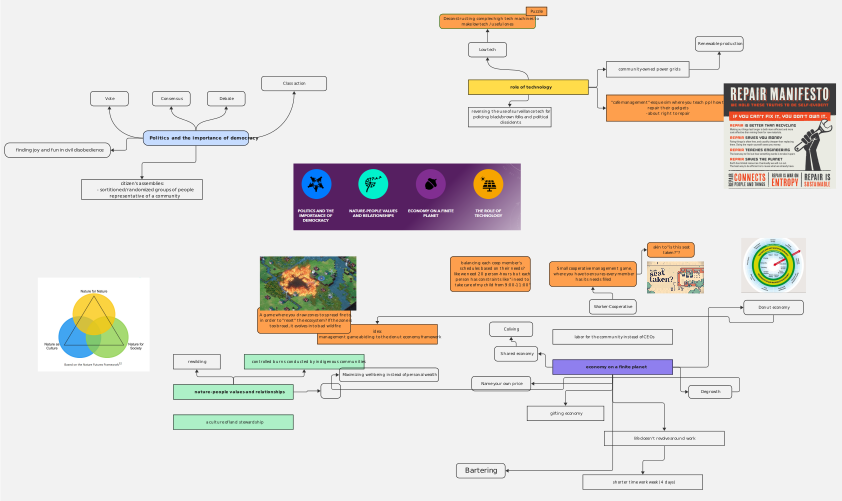
The brainstorming whiteboard (game ideas are in orange)
There was a management pattern emerging across our ideas, and the one we were the most drawn to was a small action/management game showcasing the Doughnut Economics framework.
In a nutshell, the theory is that the economy should be above a social foundation while staying under an ecological ceiling, ensuring people’s needs are met without making Earth an unhealthy place to live.
Leslie drew sketches of our concepts while we were sleeping.
Second day
Because I was a bad timezone computer, I didn’t plan to be stuck with real, boring work all day instead of working on the game.
As we explored the ideas, we finally chose the “sustainable forestry anti-breakout” one.
The objective was to balance wood chopping with forest health in a Doughnut-inspired way: you need to chop a certain quantity to provide to your people, but not too much to keep the forest healthy and allow it to regenerate.
And the chopping gameplay was inspired by old-school Breakout: you would throw a bouncing sawblade instead of the ball.
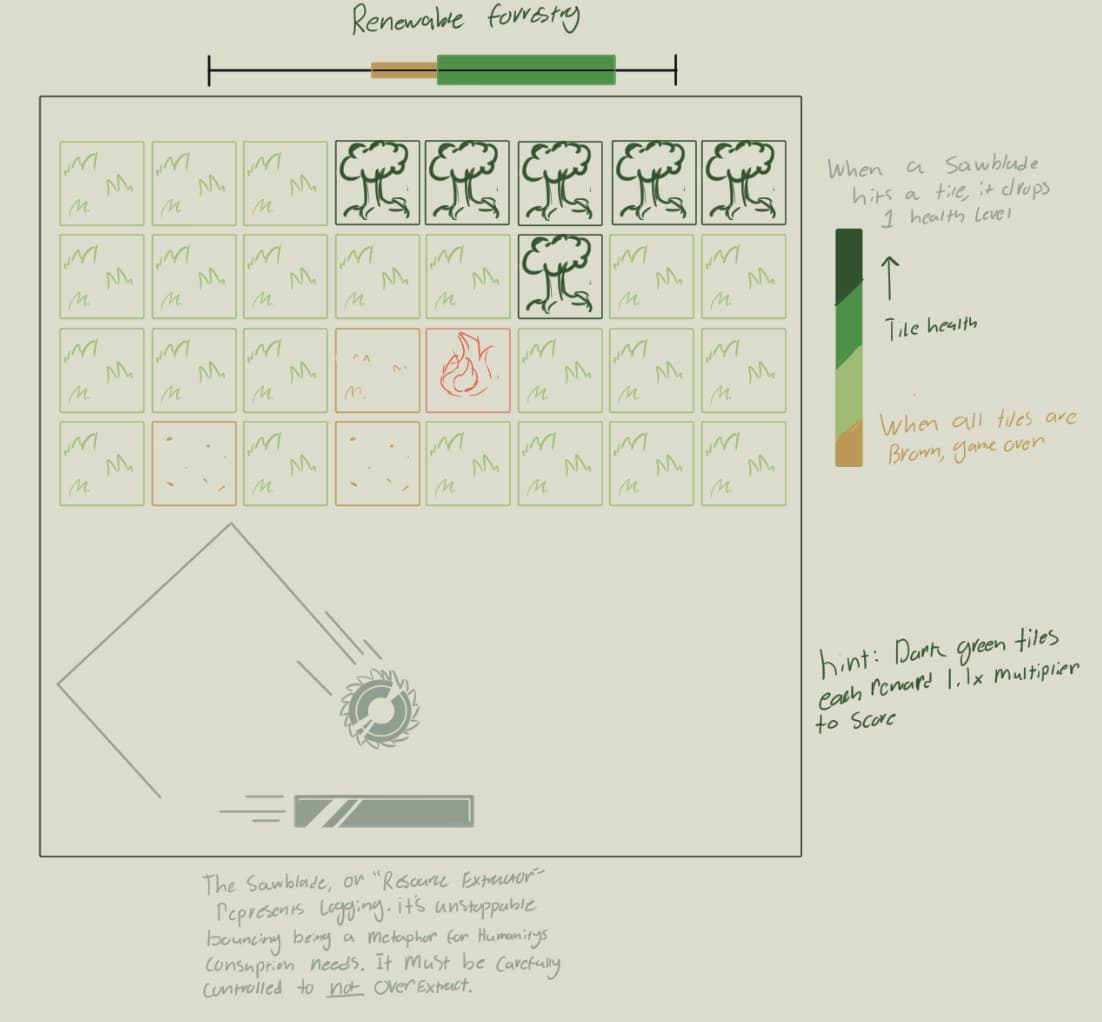
Leslie's original sketch
We just had time to vote on this concept before Leslie went to bed (did I say that timezones were a nightmare already?).
While she was sleeping, Derek and I started working on the breakout prototype.
But mechanics weren’t that clear, and after a sync call, we chose to lean more towards Puzzle Bubble than Breakout: the player will throw the blade with a particular angle to reach a specific zone in the forest.
The latter would be composed of several varieties of trees.
You will have to fulfil quests requesting an amount of a specific variety.
Leslie started on graphics for tree tiles, Derek tackled the bouncing physics, and I managed to create the order generation and forest tiles system.
While I was sleeping, Leslie changed the varieties she had chosen (Rimu, Beech and Kauri - New Zealand’s trees) because a mentor of the jam (environmental experts you could chat with, that’s something else I haven’t seen in others jams!) told her that they were all endangered and not used for logging. So we ended up with Pine, Blackwood and Macrocarpa. For sure, I didn’t know before the jam that I would learn those odd trees names!
Third day
I was hoping to get a playable prototype quickly, but struggled with integrating the art on a hexagonal tilemap.
We still had the main loop to code: wood requests are generated, you can fulfil them if you have enough of the required variety, and you have to “survive” enough time to win.
We worked, and worked, and at some point, everything was here to play the game.
Then we started seeing the cracks in the design, and we tried to balance the gameplay by adding a refiling mechanic for the sawblades. Derek began thinking about music and sounds, and Leslie drew the remaining background and UI art.
For the music, we tried a cosy vibe one, but it wasn’t fitting for the frantic gameplay we created, so Derek chose this one from the royalty-free legend Kevin MacLeod and added his touch with assets from personal projects.
I was obsessed with nailing the gameplay, and tried to balance difficulty to be in the flow zone: a bit of challenge, but still easy to let players see the end.
Because it was already too late in my timezone, I wasn’t able to host playtests, but Derek did, and we used the feedback to adjust the legibility of the game.
Finally, we made the itch page and pushed our first build on it!
This was an exhausting 10 hours-dev day.
Last day
This last day was a short one for me: I had **3 hours **before deadline!
Leslie did title and how-to-play screens with a nice key art. She even added a gorgeous swaying-trees animation.
With Derek, we pushed small features to polish as much as we could before deadline, pushing builds every 30 minutes to ensure we had something even if Itch.io (the website hosting our game) would crash.
I added randomness “knobs” everywhere to make the gameplay a bit more “organic” but there wasn’t enough time left to tune them perfectly.
By playtesting it so much, we found out that even if the game was encouraging waiting with the limited sawblades mechanic, you could win by clear-cutting all the forest!
That was a direct contradiction with our design pillars.
Sadly, there wasn’t enough time to implement a forest health mechanic which could have been the missing piece of this game of balance.
And we were done!
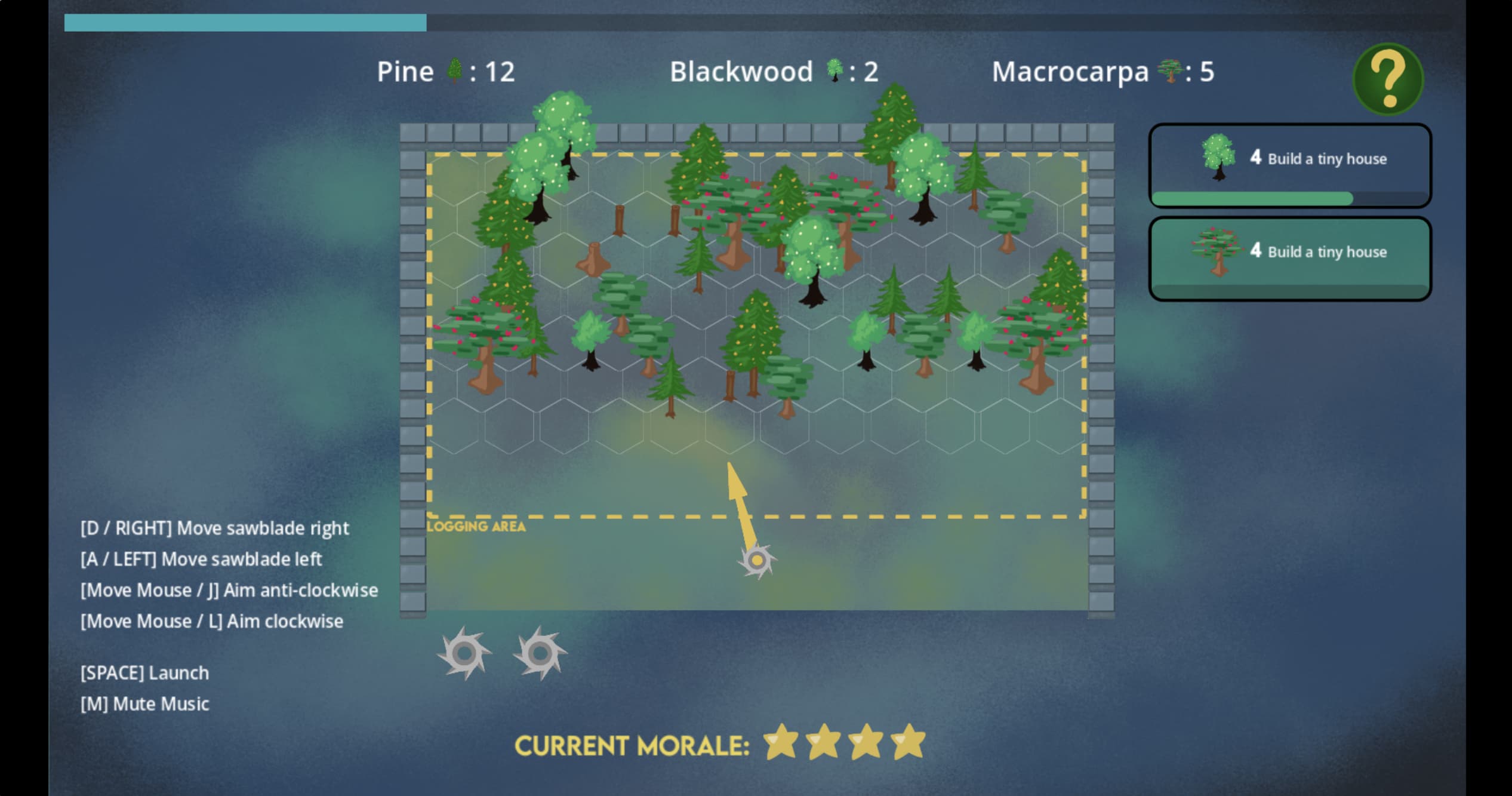
The final game
Ratings
We had 2 days to play the 20 entries of this edition (yes, compared to my others jams, this was a tiny one!).
I played 12, because I could only allow it few hours.
I saw great concepts and art. Some even made an audio tabletop role-playing game which was complete UFO, but creative!
With 14 ratings, we scored #2nd in Gameplay (again, seems to be a pattern in the games I’m making!) and #9 in Aesthetics.
Key takeaways
- Timezones differences need extra and precise planning: ideally, each shared time window should be treated as progress status.
- Thinking about wide topics while having a clear “make a game for good” direction actually gives a lot of diverse ideas.
- With a slightly complex gameplay, you need a clear Design Document for the team to be in sync before starting development.
- Complex gameplay should be stress-tested on paper before implementation (when it’s possible).