
Why did I make this?
This was the third product of my marti startup. And the only one generating revenue…yeah!
Initially, the plan was to upgrade the existing ecological-coach mobile app with a working marketplace of eco-conscious brands.
There was already a marketplace tab, but it was a fake one to test engagement.
We had identified the marketplace model as the most promising one to finally build a working business model.
Because users were interested in discovering «good brands» and those were desperately in need of exposure.
Besides, I thought it was the perfect time for a full rewrite of the app with a new technology (React Native), so I started working on recreating existing features in early 2023.
But I stopped abruptly without finishing.
I can’t remember exactly what triggered this radical change, but I know I had just (re)discovered three mind-blowing books: The Lean Startup, The Mom Test and The Lean Marketplace.
They changed my mind: rather than building a shiny new product, I had first to check if there was a market for it (asking my mom was not sufficient) and build a «quick and dirty prototype» that would validate the business model (in this case, a working marketplace).
Starting with user interviews
As I was developing the new app, I conducted 5 interviews (and had plans for more) with people that were already buying from eco-friendly brands.
It helped me identify their approach to sustainability, products they were buying, which criteria they used to choose, and where they bought them.
Even if I didn’t talk to a lot of people, I was able to find patterns in these interviews; for example, the products people were buying related to their ecological sensibility.
These results strengthen my idea of a smart marketplace that would recommend products based on the ecological profile of the customer.
The idea was to first provide value by measuring the personal «ecological footprint» (a simple version of it) of the user, then encourage them to buy products that would improve this footprint.
To keep the ecological «positive» effect of the project, products would be picked wisely, and instead of a basic storefront, marti would be more of a habit-changing platform: solid cosmetics to replace common liquid ones, reusable water bottles to replace disposable plastic ones, eco-friendly shoes, and more.
I thought I found a compelling, unique new way of designing a marketplace.
However, it turned out to be the thing that hindered customers’ understanding of the product.
Building a no-code prototype
This product was a complete change in my vision of product building.
I’m a software engineer, so building products usually meant writing code (and good one, it was before good generative AI tools).
But I had become convinced by the concept of a real Minimum Viable Product:
- Test «leap of faith» assumptions (how you’re going to make 💰 basically);
- as quickly as possible.
Besides, I was practicing no-code tools in freelance work. These tools were designed to allow non-developers to create digital products.
And for me, they gave the power to work quickly by using premade «software pieces» that could be fitted in a working jigsaw (more on that in the Tech section).
The result is sometimes a bit clunky. So that was perfect for an MVP.
I created a user journey to answer this question: will customers buy personally recommended eco-friendly products based on their ecological footprint?
- First, the user was invited to answer a questionnaire about their daily habits on a Google Form.
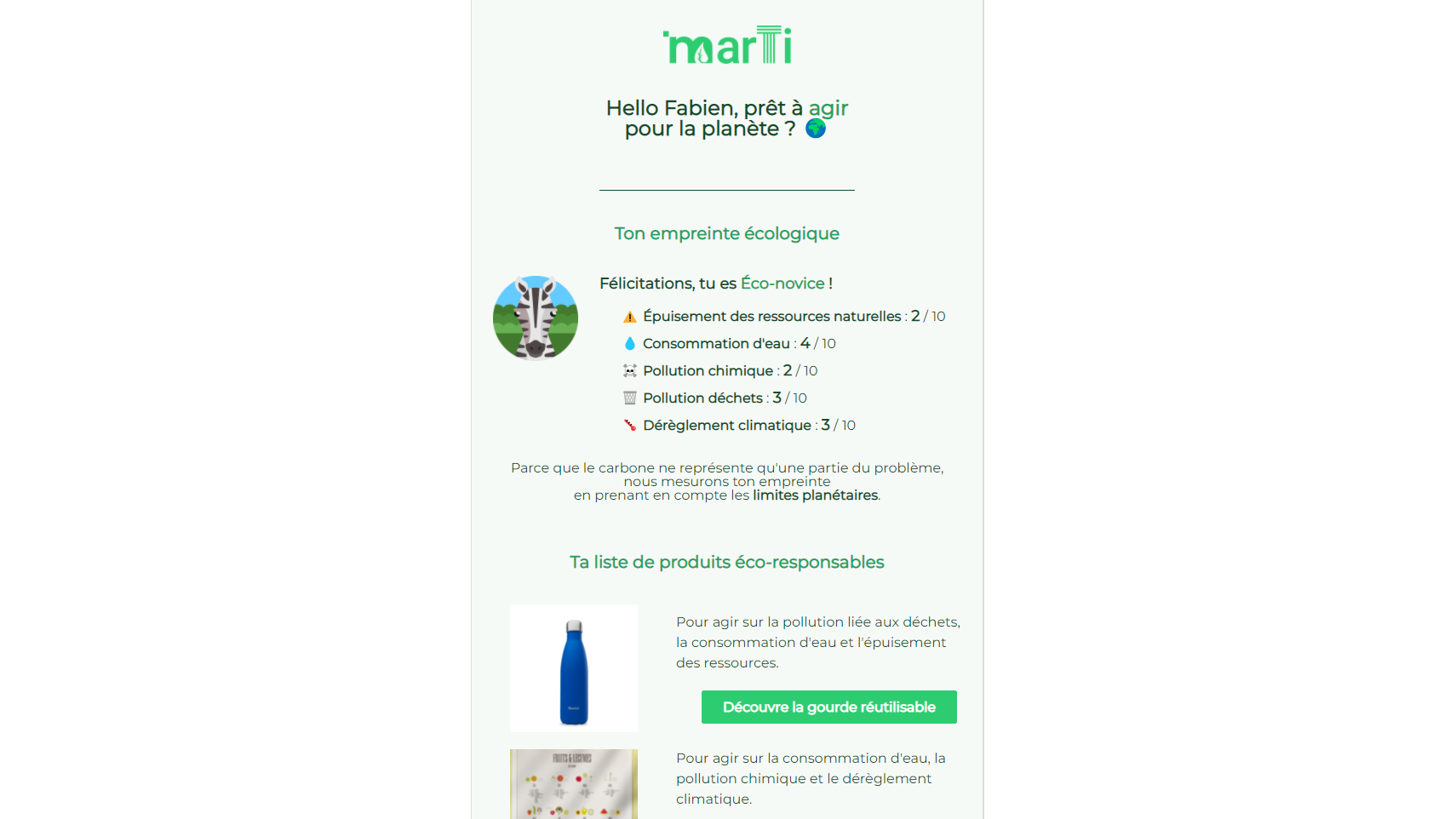
- Based on the result, the system measured their «ecological footprint» across impacted natural resources (water, waste, chemical pollution, climate change, and natural resource depletion) inspired by planetary boundaries.
- I used this profile and their answers to select 3 habit-changing products for them.
- They received an email with their ecological footprint summary and the links to buy their recommended products (click on the first image above).
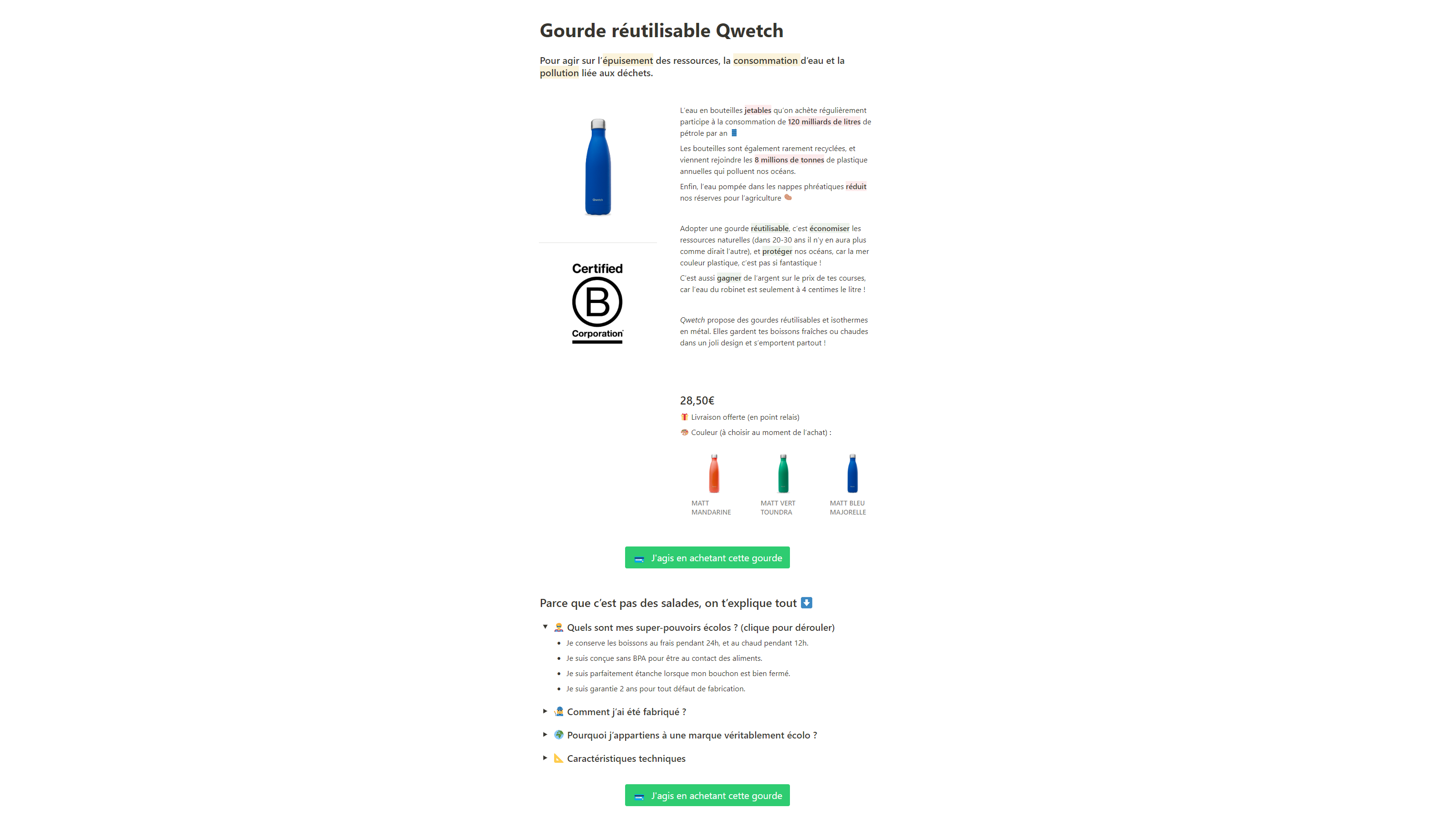
- By clicking on a product link, they were taken to a listing page (on Notion) comparing the bad common habit with the ecological one enabled by this product and giving exhaustive facts about its composition, manufacturing, and brand.
- If the user bought the product, I ordered it manually from the brand website with their info and forwarded tracking information to them.
As you can see, this was a hands-on process for me, camouflaged in a clunky but good enough platform (this is called a Wizard-of-Oz MVP).
The important thing I wanted to validate was that users would be pushed enough by the process, starting from measuring their personal ecological footprint to buying a habit-changing ecological product from me.
Moreover, I already knew that ecological brands craved more customers, so there was no risk on the supply side of the marketplace. That’s why I found this drop-shipping method a good shortcut to start selling without striking commission deals with the brands.
The goal was to test conversion, not make revenue yet. So prices were a bit higher than on brands websites, just what was needed to pay for credit card fees.
As a matter of fact, I got this idea by learning about the MVP of Zappos, a famous online marketplace that started with its founder taking photos of shoes in brick-and-mortar shops and putting them on its website.
At the end, I built the first version in only one month!
As expected, it took way less time than building a shiny product, especially a mobile app.
Being mobile or having a beautiful interface wasn’t needed for making revenue.
Beta testing
As soon as the user journey was complete, I started testing with friends and family.
It helped me refine the questionnaire, the product pages, and recommendations.
I added more products, searching for the most trustworthy eco-friendly brands, and even struck a 10% commission deal with a cosmetics brand.
Then I sent a campaign to users of the legacy mobile app, offering them to test the new experience by joining a waiting list.
I took a «build-only-if-asked» approach, writing product pages only when they were recommended for the first time.
Then, bit by bit, I automated every mail with the user, the recommendation, and feedback steps, the only remaining manual work that had to be done. The external service didn’t change. But its internals were much faster.
Public testing
Tests were encouraging, but I knew I needed a lot more users to make the first sale.
So I redesigned my landing page, prompting visitors to subscribe to the waiting list, which was at this point only a marketing tactic to make them feel special.
In fact, as soon as they subscribed, I sent them automatically the first email with the questionnaire.
And…it worked! I got some sales from people I knew and even complete strangers. That was a great achievement for me.
But a marketplace business needs more than a few sales. It needs recurring sales to ensure stable revenue.
Seeking scale
To create traffic on the marketplace, I needed strong acquisition channels: social media.
This was already a subject for the mobile app, and now it was compulsory for this project to work.
Because I knew I couldn’t split myself too thin, and also because I was feeling lonely since my former cofounder left a year ago, I decided to find a new cofounder.
I took time to write a post, send emails, and meet candidates.
I was searching for a commercial or marketing profile: pitching brands and making posts on social media would become unavoidable quickly.
Some senior profiles were very interesting, but they couldn’t join without income and had trouble seeing the viability of the current strategy.
Issues
At the end of the year, the cracks were becoming visible:
- A marketplace business needs to push its customers to buy a lot of products, even if they don’t want them → not that eco-friendly.
- Users were confused: why couldn’t they see all available products, like all marketplaces?
- I had the same problems the brands I was selling for had: not enough visibility.
- It was still too soon to make expensive ad campaigns.
Having just discovered the mind-blowing Running Lean book and its simple viability test, I was also becoming increasingly aware of the sales volume needed to just pay myself.
Raising money would be necessary.
I was searching for new hacks to boost acquisition of the marketplace when I stumbled upon a new, very promising concept that seemed to solve every problem: what if marti was embedded in the user’s browser, guiding them on every site?
Key takeaways
What I learned from this project:
- you can learn a lot with carefully scripted user interviews;
- a Wizard-of-Oz MVP is the perfect way to quickly test a new product idea;
- the supply side of a marketplace can at first be faked;
- names matter: calling something a marketplace that doesn’t look like it is bad marketing;
- B2C products are acquisition-heavy: you need a prepared social media strategy and an advertising budget;
- solo-entrepreneurship is tough: crucial things like acquisition need to be your priority.
Tech
Curious about the bricks I used to make this clunky but working platform? Let’s dive in:
For the ecological footprint questionnaire, I used the Google Suite:
- Google Forms for the questionnaire;
- Google Sheets to collect answers;
- Google Apps Script to compute the user’s profile based on their answers (a Google-hosted JavaScript runner that has access to Google apps APIs).
Then, I used Airtable, a nocode database with automation, to centralize users, products, and orders, providing a neat out-of-the-box back office for every operation.
Product pages were written on Notion, which provided a complete-enough CMS to build ok-ish layouts.
Payments were made through Stripe payment links.
I had to cheat a little to embed big green buy me buttons in Notion with a third-party service.
Transactional emails were sent through the Brevo API, and I generated neat HTML cross-platform email templates (email clients are still stuck in the 2000s web—that’s crazy) with MJML.
Automation between these platforms was powered by Make.
But the most hacky thing I made was customizing the Notion interface with Cloudflare Workers.
This allowed running a script before serving the page to the user, which visited a custom marti domain.
I was able to remove Notion branding and disable auto dark mode (that were big UX issues for users) with this trick.
I even built a simple A/B testing system and was planning to inject analytics into the page as well.